
Industry-Leading
Attack Surface Management
Cyble specializes in securing digital assets through extensive attack surface management, actively protecting against threats to Web & Mobile apps, cloud devices, domains, email servers, IoT devices, and public code repositories. Our focus is to ensure the safety and integrity of your online presence.


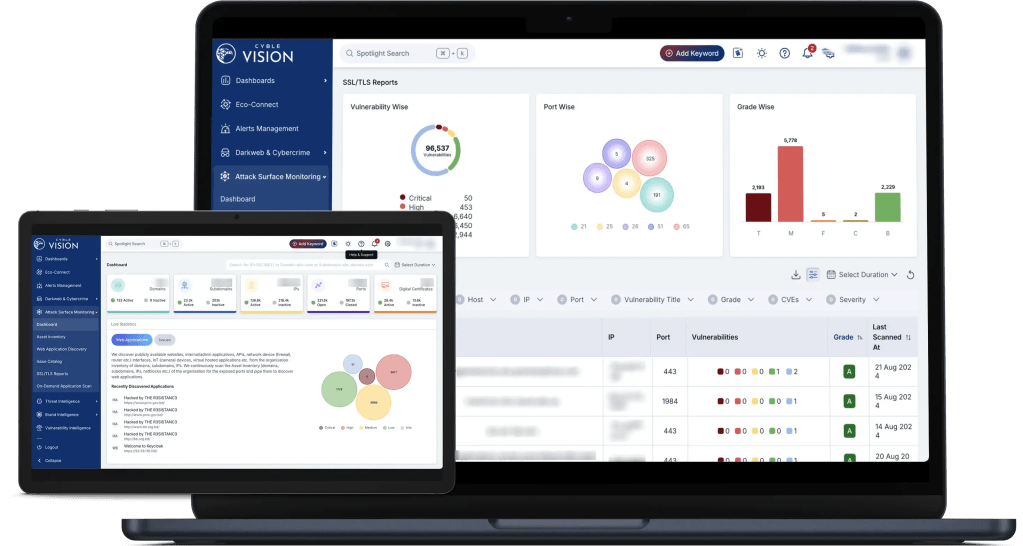
How it Works
Identify and secure all areas that could be targeted in your Attack Surface
Eliminate Digital Risks
Identify internet-exposed assets before they act as unauthorized entry points for hackers.
Eliminate Blind Spots
Analyze thousands of posts using AI classifiers and advanced analysis models such as Natural Language Processing (NLP) to uncover leaked data and detect relevant attack discussions.
Detect and Respond
Determine the impact of data breaches or misconfigurations of your cloud storage.
Features
Uncover and Secure Every Aspect of Your Attack Surfaces that Could be Targeted
-
Asset Discovery
By utilizing a centralized view, you can streamline your management of potential attack points, expedite your investigation of security incidents, enhance your vulnerability assessments, and effectively mitigate risk. -
Actionable Context
Gain a comprehensive understanding of your potential points of vulnerability by obtaining a current and historical view of all your internet-connected assets, both on-premises and in the cloud. -
Application Security Scanning
Application Security Scanners are automated tools that scan web applications from the exterior to detect security vulnerabilities such as Cross-Site Scripting (XSS), SQL Injection, Command Injection, Path Traversal, and insecure server configurations. -
Code Repository Analysis
Cyble leverages advanced scanning tools and AI-driven analysis to scrutinize code repositories, uncovering vulnerabilities and ensuring secure code practices. -
File Hashes Detection
Our detection approach utilizes a blacklist of harmful file hashes. We analyze network traffic, evaluate all connections, and calculate the MD5, SHA1, and SHA256 hash for every new file identified in the transfer of a connection. We perform a thorough examination of network traffic, analyzing all connections made and generating unique hash values, specifically the MD5, SHA1, and SHA256 hash, for every new file identified during the transfer of a connection. This allows us to quickly and effectively identify potential security risks. -
Cloud Storage Analysis
Cyble assists you in identifying instances of data leakage or assets that have been publicly exposed in various cloud storage solutions. Cyble enhances your ability to detect and mitigate data exposure risks by offering a comprehensive examination of cloud storage solutions, in order to identify instances where sensitive information or assets may have been leaked or made publicly available.
-
Vulnerability Management
Full context on vulnerabilities in valuable resources within an organization, with the goal of improving overall security. -
Asset Intelligence
Cyble Asset Intelligence specializes in identifying security vulnerabilities in various areas of a network. It conducts regular scans to look for any new or existing vulnerabilities that could potentially be exploited by attackers. By identifying and analyzing these vulnerabilities, Cyble Asset Intelligence helps organizations to better understand the risks they face and to take appropriate steps to protect themselves against potential cyber attacks. -
IP Risk-Scoring
The IP Risk Score generated by Cyble gives an indication of an IP address being linked to harmful activity, based on intelligence gathered from various IP threat sources. -
New Port Discovery
Cyble Asset Intelligence is capable of discovering new ports on a network, which are entry points for data transmission between devices. -
SSL Expiry Alerts
Cyble helps you keep your websites secure against various cyber threats by constantly monitoring the expiration status of the Secure Sockets Layer (SSL) certificates used on the website. SSL is a security protocol used to establish an encrypted link between a server and a client, typically a web browser. -
Domain Expiry Alerts
By tracking the expiration date of domain registrations, Cyble Asset Intelligence helps you proactively renew your domain registrations before they expire, preventing any potential disruption to your online presence.
Attack Surface Management FAQs
An attack surface is comprised of all vulnerabilities, pathways, or methods, otherwise known as attack vectors, that a hacker may exploit to infiltrate networks, access sensitive data, or execute cyberattacks without authorization.
Attack Surface Monitoring continuously scans and tracks an organization’s digital assets, identifying vulnerabilities and potential attack vectors. It helps security teams stay aware of risks and take proactive measures to protect systems.
Attack Surface Management (ASM) safeguards against cyber threats by providing companies with comprehensive insights into their internal and external attack surfaces, encompassing all vulnerabilities, entry points, and potential avenues for attacks from various sources.
ASM covers a range of digital assets, including but not limited to:
- Websites and web applications
- Domain names
- Cloud resources
- IoT devices
- APIs
- Mobile apps
- Shadow IT resources
- Third-party integrations
ASM offers numerous benefits, including:
- Reduction in overall cyber risk
- Improved security posture
- Comprehensive visibility into the external attack surface
- Better regulatory compliance
- Reduced likelihood of data breaches and associated costs
External Attack Surface Management oversees cybersecurity vulnerabilities linked to an organization’s outward-facing digital resources. This method encompasses vigilant surveillance, detection, minimization, and alleviation of risks within an organization’s external attack surface.
An attack vector serves as the pathway or method through which an attacker or hacker gains entry to a computer or network server, intending to deploy a harmful payload or achieve a malicious outcome. These vectors empower hackers to exploit system vulnerabilities, encompassing technical weaknesses and exploiting human factors within the system.
The frequency of conducting these assessments relies on various factors, such as the organization’s size, the intricacy of its attack surface, and the associated risk level. Optimal practice suggests that rather than intermittently, attack surface management should ideally occur on a continuous basis.
Determining the priority for addressing vulnerabilities depends on factors such as the organization’s attack surface, risk level, and exploit potential. Organizations should prioritize based on severity ratings, the probability of exploitation, impact on business operations, and the criticality of compromised assets.
Attack surface management comprises various core functions operations such as asset identification, vulnerability evaluation, threat modeling, and risk administration. Asset discovery specifically focuses on recognizing every device and system linked to an organization’s network.
To mitigate Attack Surface risks, organizations must first fully assess the extent of their Attack Surface across websites, portals, apps, etc. Once the Attack Surface has been mapped, organizations can audit all aspects of their Attack Surface to address any weaknesses, patch vulnerabilities, and consolidate vulnerable online assets in preparation for remediation efforts.
ASM can help protect against incidences of cyberattacks by assessing the entire attack surface, bringing to light any vulnerabilities or security flaws/exposures. Once these are identified, an organization’s infosec team can initiate remedial measures to secure their attack surface, either intenally or with the help of Cyber Threat Intelligence such as Cyble.
The frequency of conducting ASM assessments relies on various factors, such as the organization’s size, the intricacy of its attack surface, and the associated risk level. Optimal practice suggests that attack surface management should occur continuously rather than intermittently.
Attack Surface Management (ASM) helps to reduce the attack surface by identifying, analyzing, and mitigating vulnerabilities associated with a company’s digital assets. ASM tools are experts in detecting and eliminating unwanted or exposed assets, misconfiguration, and other security flaws that cybercriminals could exploit by continuously monitoring and assessing internal and external assets. This proactive approach ensures that potential entry points are decreased so that cyber threats are reduced, hence minimizing the company’s overall risk.
Attack Surface Management, or ASM, finds exposed assets and related vulnerabilities for prioritization and remediation. ASM scans external and internal attack surfaces, offering continuous monitoring, threat intelligence integration, and real-time insights. It helps companies understand their digital footprint, find shadow IT, and ensure compliance with regulatory needs. By prioritizing risk based on criticality, ASM helps efficient resource allocation and swift incident response.
Attack Surface Mapping is the procedure to identify and document all entry of digital assets that cybercriminals could exploit within a company’s infrastructure. It includes external and internal assets like applications, servers, networks, and API endpoints. These digital assets aim to create a comprehensive inventory of these assets by understanding their interconnections and assessing their security posture to mitigate vulnerabilities effectively.
External Attack Surface Management (EASM) is identifying and analyzing applications, cloud services, and network infrastructure accessible from outside the company. EASM includes continuous monitoring and securing exposed assets to prevent data breaches and unauthorized access by cybercriminals or threat actors. The primary function of EASM is to proactively mitigate risk based on external attack surfaces for safeguarding against potential cyber threats.
Yes, you can utilize Cyble Vision to manage the attack surface. Cyble Vision offers advanced threat intelligence and continuous monitoring of your digital assets. Vision helps you find exposed digital assets, prioritize vulnerabilities, and provide actionable insights to reduce the attack surface. With its advanced AI-powered threat intelligence, it effectively filters out noise and focuses on main threats, enabling quick response and mitigation.
Attack Surface Management is vital as it gives companies the visibility, context, and priority required to address vulnerabilities before cybercriminals exploit them. By continuously monitoring and managing internal and external internet-connected assets, ASM helps decrease cyberattack risk and enhance cybersecurity posture. This proactive approach ensures that the security operations team is aware of potential vulnerabilities and takes steps to mitigate them before they have been exploited.
Attack surfaces include a comprehensive pointer where an attacker can access any company’s digital assets and data. Some examples are given below:
- Applications: Web and mobile applications and APIs accessible outside the company.
- Websites: Public, internal, and e-commerce websites hosted by the company.
- Networks: Internet, private networks, and cloud networks used by the company.
- Devices: Laptops, smartphones, servers, and IoT devices connected to the company’s networks.
- Cloud Infrastructure: Public clouds, private clouds, and hybrid clouds used by the company
Attack surfaces include a comprehensive pointer where an attacker can access any company’s digital assets and data. Some examples are given below:
- Applications: Web and mobile applications and APIs accessible outside the company.
- Websites: Public, internal, and e-commerce websites hosted by the company.
- Networks: Internet, private networks, and cloud networks used by the company.
- Devices: Laptops, smartphones, servers, and IoT devices connected to the company’s networks.
- Cloud Infrastructure: Public clouds, private clouds, and hybrid clouds used by the company
- Attack Surface: The attack surface refers to all potential vulnerabilities and entry points attackers can leverage to gain unauthorized access to an organization’s systems and networks. It includes both digital and physical components.
- Attack Vector: An attack vector is a method or pathway used by an attacker to exploit vulnerabilities within the attack surface. Examples include phishing, weak passwords, and outdated software
A practical attack surface management solution should:
Continuously Discover and Inventory Assets: Find all known and unknown assets, including shadow IT and third-party assets.
Monitor Assets in real time: Monitoring of assets for changes and potential vulnerabilities.
Analyze and Prioritize Risks: Assess the risk associated with each asset and prioritize them for remediation.
Implement Remediation Measures: Apply security controls, patch vulnerabilities, and enforce compliance policies.
Provide Contextual Threat Intelligence: Provide insights into vulnerabilities and threats to assist in prioritizing remediation efforts.
Enable Collaboration: Facilitate communication and coordination among different teams within the organization
The core function of ASM includes various crucial processes that collectively enhance the company’s security posture. These functions include:
- Discovery: Conduct comprehensive scanning to find known and unknown assets within the network. It includes application builds, hardware & software from supply chain partners, and more. Continuous Discovery is vital as the attack surface grows and evolves.
- Testing: Regularly test applications and systems for vulnerabilities utilizing dynamic application security testing (DAST), static application security testing (SAST), and application penetration testing.
- Context: Provide contextual insights into potential risks and threats. It includes understanding the public accessibility of assets, the presence of vulnerabilities, and the association of resources with business-critical applications.
- Prioritization: Assess and prioritize vulnerabilities based on their risk and potential impact. It includes assigning security ratings or risk scores to vulnerabilities to determine the most critical issues that need immediate attention.
- Remediation: Implement measures to address identified vulnerabilities. This can involve applying patches, updating configurations, and decommissioning obsolete systems. Automated remediation can help rapidly address potential threats.
- Monitoring: By continuously monitoring and scanning the network for new vulnerabilities and changes in the attack surface. Real-time monitoring allows quick detection and response to emerging cyber threats.
By effectively using these core functions, companies can gain comprehensive visibility into their attack surface, prioritize remediation efforts, and proactively defend against cyber threats.
Attack Surface Management identifies and monitors all digital assets and vulnerabilities in real-time, enabling organizations to reduce their exposure to potential threats and proactively mitigate risks.
Some of the common tool in attack surface management include Cyble, Palo Alto Networks Cortex Xpanse, Randori Recon, and Qualys for discovering, assessing, and managing external and internal attack surfaces.
Organizations implement an Attack Surface Management strategy by identifying all their digital assets, assessing vulnerabilities, and continuously monitoring for risks. Automation tools and threat intelligence are often used to streamline this process and reduce blind spots.
Attack Surface Management helps businesses identify, monitor, and reduce risks by providing visibility into their digital assets, detecting vulnerabilities, and mitigating potential threats before attackers exploit them.
Resources
Attack Surface Management
Data Sheets
Request a personalized demo and discover how our advanced threat intelligence can empower your organization’s cybersecurity strategy. Witness the integration of our solutions with your existing security tools and understand how we can help you navigate the complex landscape of cyber threats.